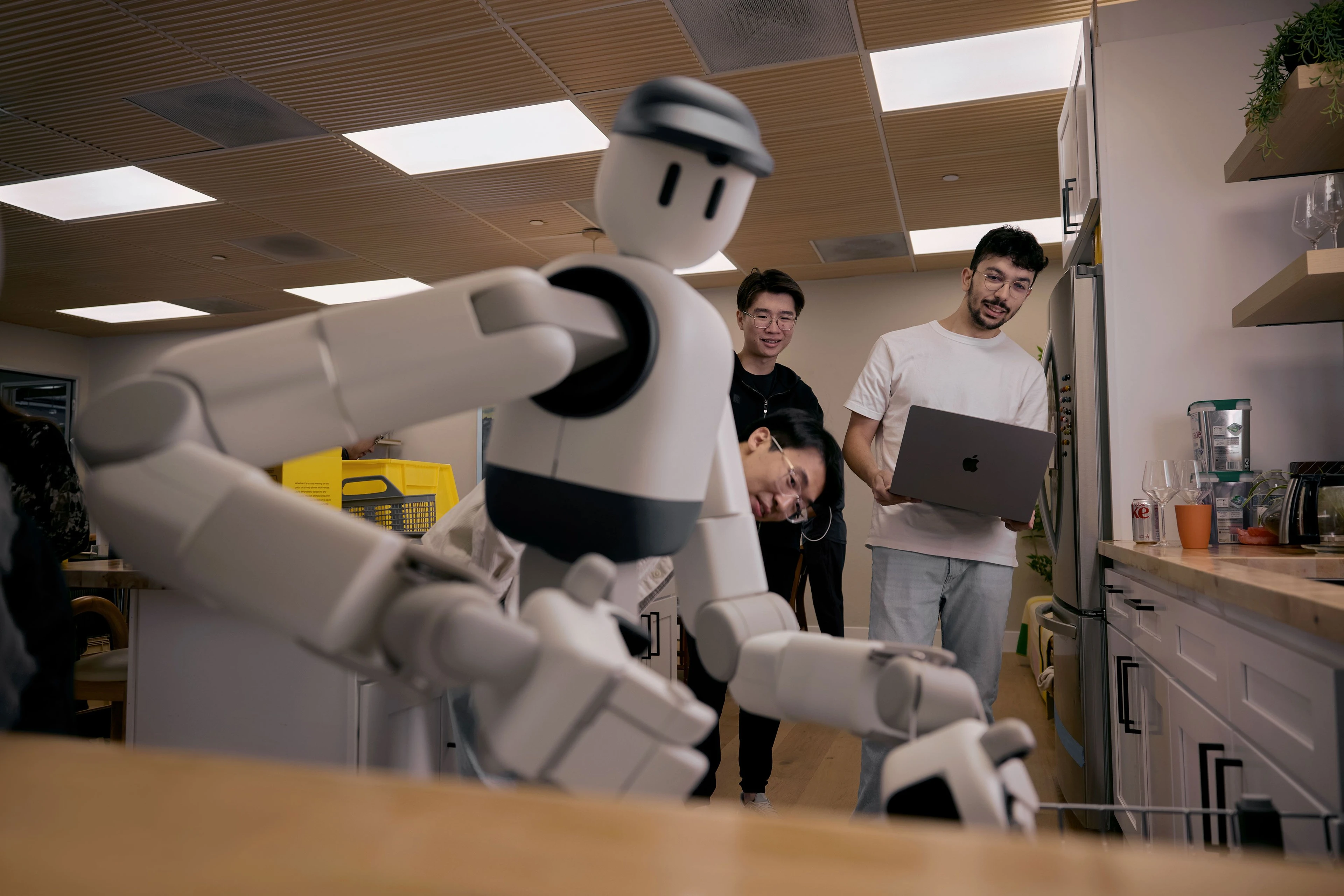
SHERIDAN, WYOMING – December 30, 2025 – A new robotics AI system called ACT-1 claims a major leap toward helpful home robots by learning complex chores without using any robot teleoperation data.
Why This Moment Feels Different From Typical Robot News
Robots that can truly help at home have always sounded close—until you think about how messy real life is. Kitchens are cluttered, objects are fragile, and tasks are long. The team behind ACT-1 says it built a robot foundation model that can tackle ultra long-horizon tasks, generalize room-scale mobile manipulation to new environments, and push dexterity forward, all without collecting a single trajectory of robot teleoperation data.
The core consumer promise is emotional, not technical: returning time to people for family, friends, and the passions they love. That’s the kind of future many people want—but the “how” has been the bottleneck.
The Big Problem: Robots Don’t Have Internet-Scale Training Data
The source argues that robotics has been stuck because it doesn’t have an internet-sized dataset for real-world manipulation. The common workaround is teleoperation—humans remotely controlling robots to create training demonstrations—but the team describes this as a deadlock. The logic is simple: you can’t deploy robots widely without intelligence, but you can’t build that intelligence without the data you’d get from large-scale deployment.
Their proposed way around this is to capture skills from humans directly, at the scale of human daily life, instead of waiting decades to collect enough robot demonstrations.
Skill Capture Glove: Matching Human Hands to Robot Hands
A key idea in the source is the “embodiment mismatch problem.” Even if you record what a human does, it won’t transfer cleanly to a robot if the robot’s hand doesn’t match the human hand. The team says it tackled this by co-designing hardware around a mechanical “sweet spot,” balancing human ergonomics and robot manufacturing needs while optimizing for the kinds of dexterity that matter at home.
The result is a Skill Capture Glove that shares the exact same geometry and sensor layout as the robot hand. The intended outcome is straightforward: actions performed in the glove can be learned by the robot without a translation gap caused by different hand shapes.
Skill Transform: Making Human Demonstrations Look Like Robot Data
Hands are only part of the story. The source notes that people vary in height and arm length, and a camera watching a human arm introduces a visual mismatch—because the robot ultimately needs to learn from a robot arm’s perspective. To address this, the team developed Skill Transform, which aligns raw kinematic and visual observations and removes human-specific details.
The source reports that converting glove data into equivalent robot data achieves a 90% success rate, producing training data that looks and moves as if it were generated by the robot itself.
What ACT-1 and the Robot “Memo” Can Do in Demos
The team says it spent over a year engineering the core infrastructure—Skill Capture Glove, Skill Transform, and its robot, Memo—and then trained ACT-1 as its first foundation model. In the last 90 days, it reports rapid progress in both dexterity and long-horizon autonomy.
Examples described include:
- Holding two wine glasses in one hand without breaking them
- Inserting a wine glass into a dishwasher
- Picking up two utensils with a single hand
The standout demonstration is a full Table-to-Dishwasher task. The source describes it as picking up delicate dinnerware from a dining table, loading a dishwasher, dumping food waste, and operating the dishwasher. During the task, ACT-1 autonomously performs 33 unique and 68 total dexterous interactions with 21 different objects while navigating more than 130 ft.
Mini FAQ: What This Could Mean for Real Homes
Q: What does “zero robot data” mean here?
A: The source says ACT-1 was trained without any robot teleoperation trajectories, relying instead on a system that translates human-captured demonstrations into robot-equivalent training data.
Q: What’s the most impressive task described?
A: The source highlights a full Table-to-Dishwasher routine involving long-horizon autonomy, dozens of interactions, and navigation across more than 130 ft.
Q: Is this a home robot you can buy today?
A: The source focuses on the technology and demonstrations, but does not state consumer availability, pricing, or a release timeline.
Learn more at https://www.sunday.ai